Two Different Problems, Two Different Solutions
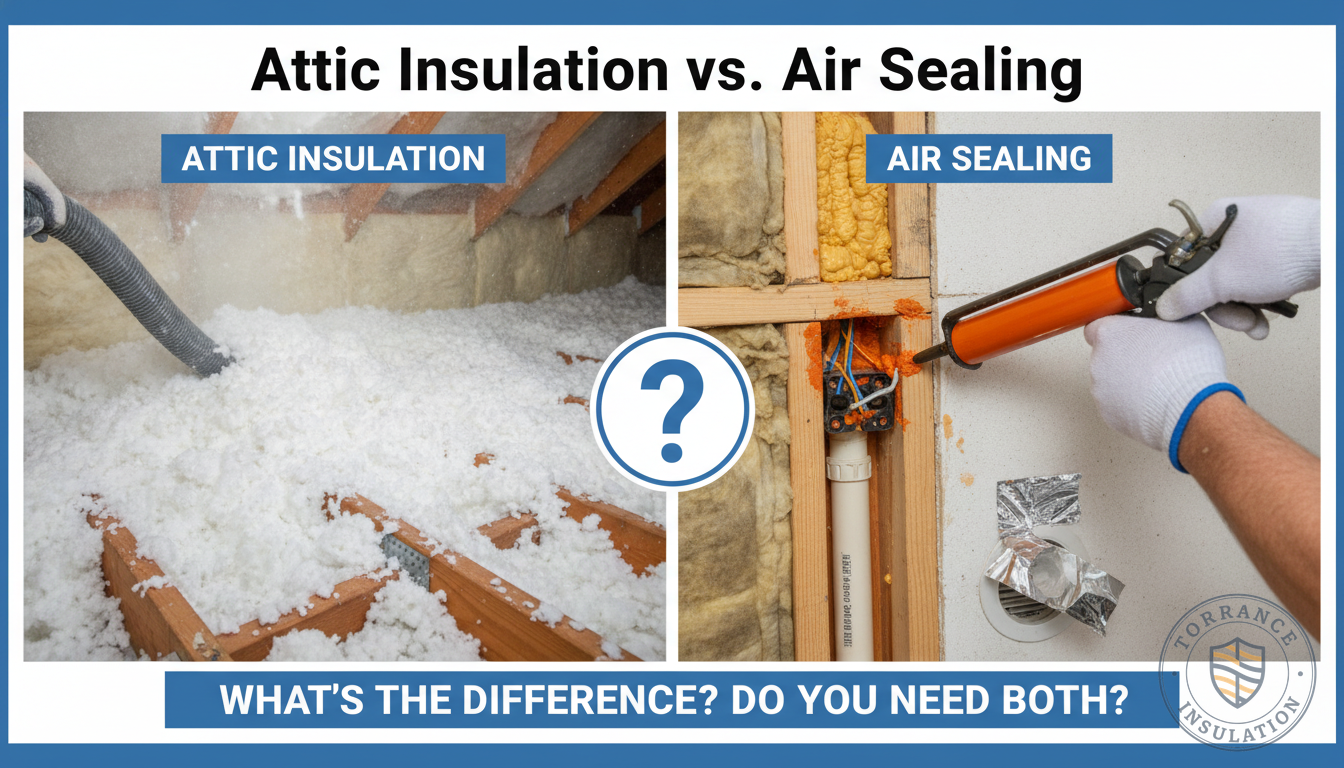
When homeowners in Torrance call us about high energy bills or uncomfortable rooms, the conversation almost always leads to the attic. But what most people don't realize is that the attic has two separate energy problems that require two separate solutions: heat transfer and air leakage. Insulation handles the first. Air sealing handles the second. And unless you address both, you're leaving a significant amount of performance—and money—on the table.
What Attic Insulation Actually Does
Insulation works by trapping still air within its fibers or cells, creating a layer of resistance that slows the movement of heat from one side to the other. In summer, it slows the transfer of outdoor heat down into your living space. In winter, it slows the escape of heat you've paid to generate. The effectiveness of insulation is measured in R-value—the higher the number, the better the resistance.
For Torrance homes in California's Climate Zone 8, the U.S. Department of Energy recommends an attic R-value of R-38 to R-60. Most homes built before the 1990s fall far short of that target. Our attic insulation installation service uses blown-in fiberglass, cellulose, or batt systems to bring your home up to or above those thresholds, measured before and after so you have documentation of exactly what was installed.
What Air Sealing Actually Does
Here's the critical point that most insulation marketing misses: insulation can only slow heat transfer through solid material—it cannot stop air movement through gaps and holes. And every home, especially older South Bay homes, has dozens of those gaps. Recessed light cans that open directly into the attic. Plumbing stacks with unsealed penetrations through the top plate. Wiring runs that punch through the ceiling framing. Attic hatches with no weatherstripping.
Through these gaps, conditioned air—the air you paid your AC or furnace to treat—flows freely in and out of your living space. Warm attic air infiltrates in summer. Cold outside air infiltrates in winter. No amount of insulation above those gaps changes this because the air is bypassing the insulation entirely.
Our air sealing service targets every one of these bypass points using low-expansion foam, fire-rated caulk, and rigid blocking materials. The result is a sealed thermal boundary that forces all heat exchange to happen through the insulated ceiling plane—where it belongs.
Which Should Come First?
Air sealing should always come before new insulation is installed. Once blown-in insulation covers the attic floor, accessing the penetrations and top plates underneath it becomes difficult or impossible without disturbing the new material. Doing it in the right order—seal first, insulate second—ensures you get the full rated R-value out of every dollar of new insulation and that the air sealing work remains intact for decades.
This is exactly how we sequence every full attic upgrade at Torrance Insulation. When old insulation needs to come out first, our insulation removal service clears the attic floor so air sealing can be performed on a clean, visible substrate before new material goes in.
Can You Just Do One or the Other?
Yes, and sometimes that's the right call. If your attic already has adequate R-value but you know you have air leakage issues, standalone air sealing can produce a noticeable improvement in comfort and energy use. If your attic is simply under-insulated and there's no major air leakage, adding insulation alone will still help.
But for homeowners who want the maximum return on their investment—and who are only going to do this once—combining both services in the same project is the most cost-effective approach. Our crews do the work in sequence, and the combined impact on your energy bills is substantially greater than either service alone.
Real-World Results for Torrance and South Bay Homes
The homes that benefit most from this combined approach tend to be the older single-story ranch homes, bungalows, and two-story houses common in neighborhoods like South Torrance, Walteria, and North Torrance. These homes were built in an era when energy efficiency wasn't a design priority, and many still have their original (minimal) insulation and completely unsealed attic penetrations.
If you've been wondering whether your home needs insulation, air sealing, or both, the most straightforward answer is to let us look. Our free attic assessment covers both—we measure your R-value, check for air bypasses, and give you a clear, honest recommendation. We also serve homeowners in Redondo Beach and
Call +14245677873 or fill out our online form for a free, no-obligation quote.Confirm Availability